What Happens Inside a Kid's Brain Playing Bullying Prevention Games
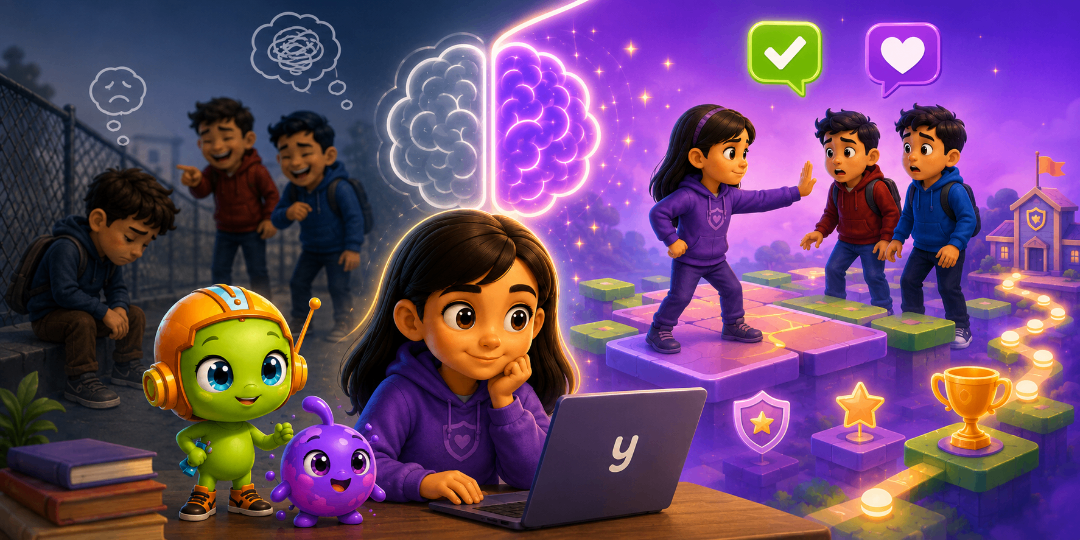
Recess ends and Maya still hasn't said anything. She saw a kid get shoved into the fence, heard the laughing, and kept walking.
Bullying is most common among children aged 10–12. According to NCES data, around 26%–28% of students in this age group report being bullied at school.
That shows how deeply rooted the issue is and why schools are still working to find better ways for elementary bullying prevention.
Here's what changes in a kid's brain when Maya practices that moment inside Yozgoo instead.
The Choice That Changes Everything
Later that day, Maya logs into Yozgoo, a web-based role-playing game built to teach exactly what she froze on at recess. It puts her in front of a kid getting teased and asks what she does next.
That single choice, made under a little pressure, teaches more than any worksheet could. Struggling toward an answer yourself builds memory that being handed one never does, and that's what most bullying prevention games skip.
Yozgoo builds around the choice, giving Maya a place to practice before she needs it for real.
Meet The Game Characters - Yoz and Fizbee
Maya lands on Yoz, arrived from Yizzle, a little lost and needing her help at school. Fizbee tags along as sidekick and comic relief. Together they lead her through mazes and challenges built around scenes she half recognizes from her own hallway.
Kids in Yozgoo's Pennsylvania and California pilot liked the same things Maya would: helping the characters through it, and Yoz and Fizbee themselves.
The Split-Second Decision Effect
Onscreen, the moment doesn't wait. Maya has seconds to decide before the scene moves on, and that pressure changes everything about how her brain processes it.
Cognitive scientists call it active engagement, the brain generating and testing a response instead of just receiving one.
That's the mechanism under good game-based learning design, and it's why one five-second choice inside Yozgoo can land harder than a five-minute talk ever could.
Backed by Clemson Research
None of this is guesswork. Yozgoo came out of a partnership with Clemson University's Institute on Family and Neighborhood Life, tested on real kids: a controlled study of 120 students, ages 10 to 12, split evenly between those who played and those who didn't.
The group that played showed measurable gains in bullying knowledge, attitude, and self-efficacy, the social emotional learning outcomes schools get graded on.
From Pixels to Playground
Practice isn't a guarantee, but it helps. A week later, Maya faces a similar situation at recess and doesn't simply walk away. She recognizes what's happening because she's been through that decision before in a safe environment.
Research suggests that skills learned through game-based activities can show up in real-life interactions, even when the impact isn't always easy to capture in formal studies.
The Ripple Effect in Real Classrooms
Maya's teacher notices too. Kids who've spent time inside Yozgoo start naming what they see, not just on the playground. A student who's practiced digital citizenship education inside the game is more likely to think twice before piling on in a group chat that night.
The awareness doesn't stay inside the screen. It follows Maya into the hallway, and it follows her online.
See the Science in Action
Every school has a Maya, a kid who saw something and didn't know what to do with it. Yozgoo is a research-backed way to close that gap, built on real decision science and tested by a real university. Play a demo and watch a kid's brain do the work a lecture never could.